
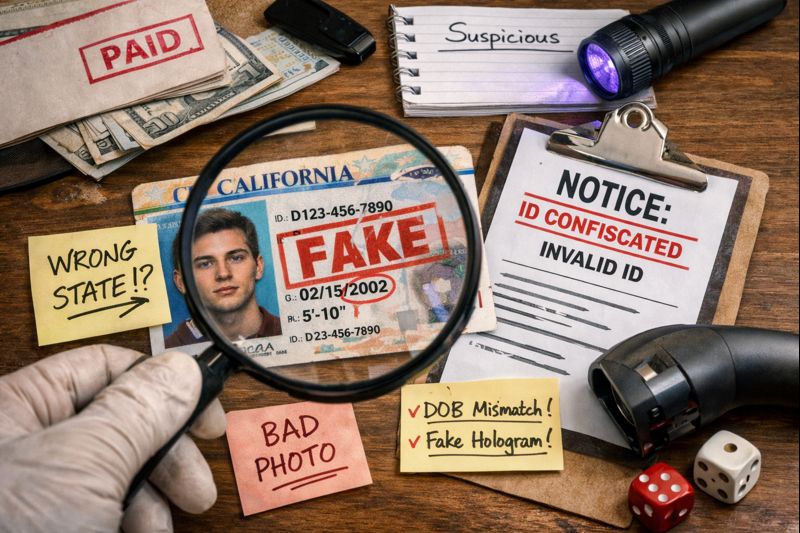
Avoid These Fake ID Pitfalls: Common Errors and Why They Get You Caught
Searches for common fake ID mistakes usually come from curiosity about how people get caught. This guide explains the most frequent errors, why they create risk, and what safer, legal options look like. It is informational only and does not offer legal advice. For a broader look at how ID checks work across settings, visit the ID verification hub.
If you are researching provider claims or review lists, it helps to understand the bigger picture. For context on online risks, see the breakdown of provider scams and data risks and why "top provider" lists are unreliable in practice.
Why These Mistakes Matter
Many mistakes do not just lead to being turned away. They can trigger citations, school discipline, identity theft exposure, or a record that appears in future background checks. The risks are often higher than people assume, and consequences can vary by state. For a broader risk rundown, see whether taking the risk pays off, and for the venue with the highest catch rate per attempt, see why cashiers catch most fake IDs at liquor stores.
Quick Takeaways
- Small errors can lead to serious legal consequences
- Online providers are a major source of scams and data theft
- Scanning or "passing" once does not make an ID legitimate
- Safer, legal alternatives exist and reduce long-term risk
Common Fake ID Mistakes People Make
1. Trusting unverified online sellers
Many people assume the biggest risk is getting denied at a door, but the more common problem is fraud. A large share of fake ID websites are built to collect payments and personal data with no delivery. If you want a deeper look at how these schemes work, read how clone sites farm the brand name. For impersonation-site examples, see the real IDGod operation.
2. Sharing photos or bragging on social media
Posting a card, a receipt, or a success story can create a permanent trail. Screenshots circulate quickly, and many cases are flagged by tips or digital evidence rather than in-person inspection.
3. Using IDs with mismatched or inconsistent details
Inconsistencies in basic information or presentation can raise suspicion. Trained staff are taught to look for mismatches that suggest the document does not belong to the person presenting it.
4. Trying to use a fake ID in high-scrutiny situations
Airports, financial institutions, and law enforcement checks involve higher standards and more thorough verification. Using a fake ID in those settings elevates the risk of serious legal consequences.
5. Believing that a successful scan equals legitimacy
Many venues rely on multiple checks, not just a scanner. A barcode scan does not establish that a document is lawful, and it does not protect someone from penalties if the ID is later determined to be fake.
6. Assuming consequences are the same everywhere
Laws vary by state, and penalties can change based on intent, use, or prior history. A choice that seems low-risk in one place may carry harsher penalties elsewhere. That mismatch in expectations is a common source of trouble.
7. Keeping or reusing a fake ID after a warning
Some people keep using a fake ID after being denied, assuming the risk has passed. In reality, repeated attempts can increase scrutiny, and prior incidents may be documented by venues or schools.
Why "Top Provider" Lists Create False Confidence
Listicles and forum posts that compare "best" options can appear persuasive, but they are rarely verifiable. Many exist for affiliate promotion or recycled content. If you came across similar search results, review this Texas-focused explainer on why those lists are unreliable and why they should not be treated as trustworthy sources. If you are searching for "fake ID bar" lists, see why Springfield rumors fall apart.
Consequences That Go Beyond Being Turned Away
The immediate consequence is often denial of entry or service. The longer-term consequences are more serious: criminal citations, school discipline, and data exposure can create problems months or years later. For what happens when IDs are seized, see the fake ID confiscation process, and for how those problems reach college admissions, jobs, and clearances, see what a charge costs you later.
- Criminal charges or citations that can affect future opportunities
- Identity theft or data misuse from online sellers
- Loss of trust at venues, workplaces, or educational institutions
Safer, Legal Alternatives
For people looking for access or convenience, there are lawful options that avoid the risks above. These alternatives can help meet identification needs without exposure to criminal penalties.
- State-issued non-driver ID cards or passport cards
- Age-appropriate venues and events that do not require 21+ entry
- Campus or community activities that support social life without legal risk
For official guidance on legal IDs and identity safety, see the U.S. Department of State passport card information, the FTC identity theft resource, and the FBI IC3 scam reporting center.
Common Fake ID Mistakes FAQs
Is it illegal to simply possess a fake ID?
FAQIn most states, possession alone can be a violation, even if the ID is never used. Penalties vary by jurisdiction.
Do mistakes always lead to criminal charges?
FAQNot always, but the risk is real. Outcomes depend on state law, venue policies, and the situation involved.
Why are online fake ID sellers considered high risk?
FAQMany are scams, and even "successful" transactions can expose personal data to fraud or misuse.
What is the safest alternative to a fake ID?
FAQApplying for a legitimate state ID or passport card is the safest path, alongside choosing age-appropriate venues.
Reminder
This content is for general information only and is not legal advice. Laws change by location, and penalties can be significant.
When you are ready to order, see the price list.
Frequently Asked Questions
What is the most common fake ID mistake?
FAQFocusing on whether the barcode scans while ignoring physical card quality. A successful scan does not fix bad laminate, wrong card thickness, or printing flaws that bouncers feel immediately.
Do people fail more from the card or from behavior?
FAQBehavior, usually. Nervous body language, over-explaining, and forced confidence push a routine check into a careful inspection long before the bouncer studies the card.
How does overconfidence backfire during ID checks?
FAQActing too casual, rushing the bouncer, or making jokes during a check reads as unnatural. Real customers are mildly indifferent. Anyone working too hard to seem relaxed draws extra attention.
Why do borrowed real IDs fail more often than fakes?
FAQBecause they fail the photo match. Bouncers compare faces, not just documents, and a borrowed real ID also escalates the legal exposure from a possession offense to criminal identity misuse. For the full comparison, see using someone else's ID vs a fake ID.
What is the smartest way to avoid these mistakes?
FAQAvoid the underlying decision. Use legal alternatives or wait until the legal age. If you already have a card, the lowest-risk choices are venues with looser checks and consistent calm behavior.